
Step 1
Assign the issue
Assign a Linear issue to SHIP, comment @SHIP on a GitHub issue, or hand work over from your terminal. The Planner reads the issue and the repository and writes the plan.
Assign an issue to SHIP. A Planner, Builder, Reviewer and Tester take it to a verified pull request, with the cost of each step.
Answer 4 questions to request access. SHIP is invite-only for now.
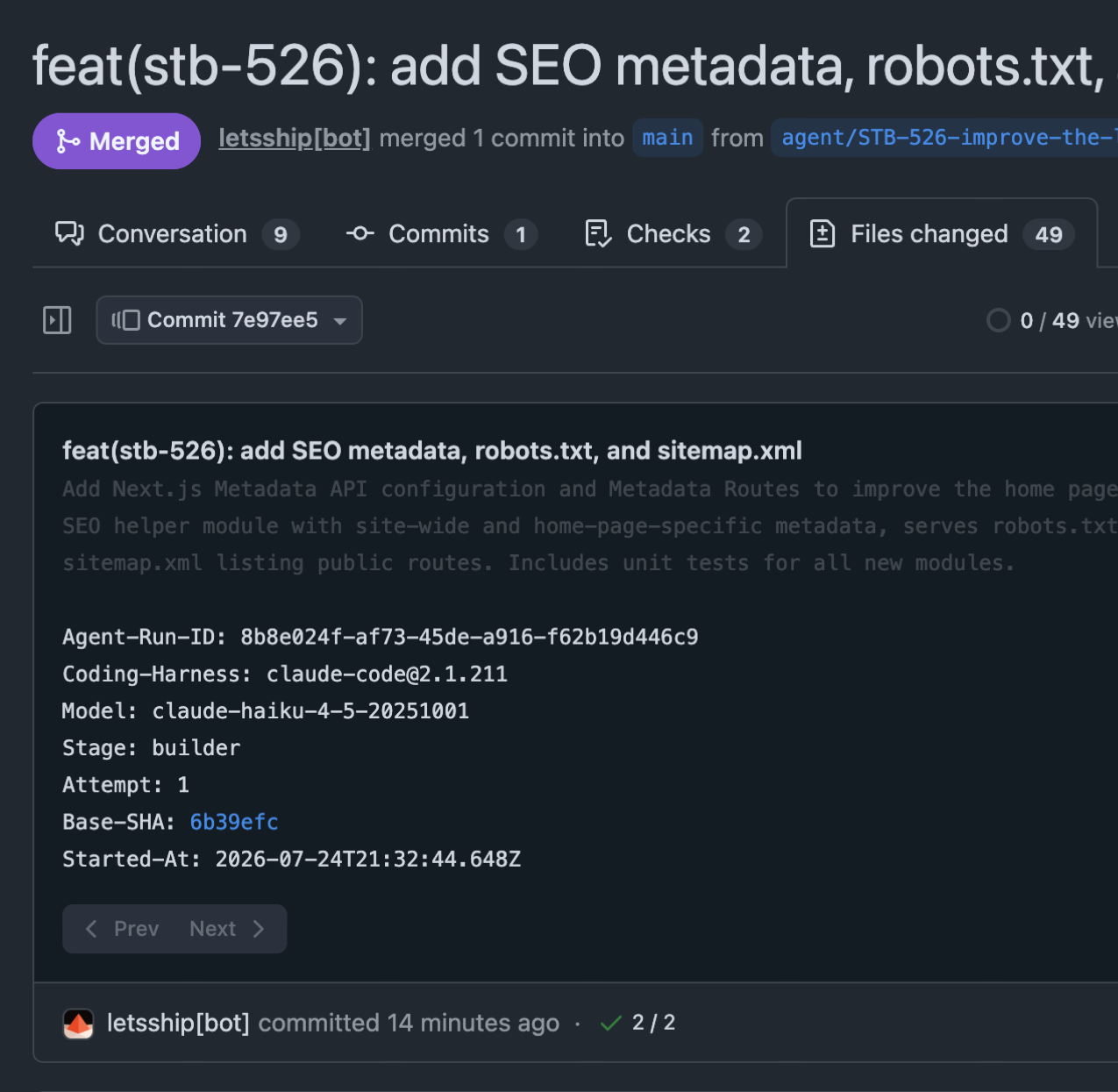
Step 1
Assign a Linear issue to SHIP, comment @SHIP on a GitHub issue, or hand work over from your terminal. The Planner reads the issue and the repository and writes the plan.
Step 2
The Builder writes the change in an isolated sandbox and runs your formatter, linter and tests before it pushes. Your CI runs, the Reviewer checks the diff against the plan, and a failed gate sends the work back.
Step 3
The Tester checks the acceptance criteria on a preview your own pipeline deploys and attaches the proof. You read the pull request, the evidence and the cost, then merge.
Set Claude Code, Codex, Pi, OpenCode or Kilo Code, on models from Anthropic, OpenAI, Z.ai or OpenRouter, for each role. Put a budget model on the build and a frontier model on the review.
Every role runs on the keys or subscriptions you connect, so your provider bills inference at your own rates.
Put a checkpoint on the Planner, Builder or Reviewer, and the mission holds when that stage finishes so you can read it and steer.
Each mission reports its cost per stage, priced at list price for the model that actually served each call.
Every mission keeps the session log of what each agent read, ran and decided, with the harness and model behind it.
Your repository's own delivery pipeline deploys each preview with its own secrets, so SHIP never holds a cloud credential.
In SHIP's SWE-in-a-team benchmark, 13 builder configurations took the same 20 tickets through plan, build, CI, review, preview deploy and test. Seven resolved all 20, and the cheapest of those cost $3.16 per resolved ticket (260 missions, published August 31, 2026).
An agentic SDLC is a software development lifecycle in which AI agents carry each change from issue to pull request through planning, building, CI, review, preview deployment and testing, and a gate that rejects the work sends it back with the feedback. People set the intent and accept the result. SHIP runs that loop on your repository with the coding agents you choose.
A GitHub repository with CI that runs on pull requests, and one model credential or coding-agent subscription. Linear and GitHub Issues both work as trackers, and so does handing work over from your terminal.
SHIP runs five coding agents: Claude Code, Codex, Pi, OpenCode and Kilo Code, on models from Anthropic, OpenAI and Z.ai or any model on OpenRouter. You set the harness and model per role in ship.yml, and a single mission can override them.
One SHIP credit covers one mission of up to 3 agent-hours, and each further 3 agent-hours, or part of them, uses one more credit. Credits come back when a mission ends in failure or needs attention with no pull request. Model usage is billed separately by your own provider.
SHIP does not keep a copy of your repository. Each run clones it into an isolated sandbox that is destroyed when the run ends. SHIP keeps each run's session log, which includes the code the agents read and changed, so you can audit what they did.
Not unless you turn it on. Merging is yours by default, and auto-merge is an opt-in you enable per project or per mission for work that does not need that gate.
Connect a repository, assign an issue, and review the verified pull request that comes back.
Answer 4 questions to request access. SHIP is invite-only for now.